

Why Your Auto Repair Shop’s Worst Day Shouldn’t Be Its Last: The Importance of Business Income Insurance
Imagine walking up to your shop on a Tuesday morning only to find a fire engine blocking the entrance. Smoke is pouring out of the service bays, the roof is charred, and your heavy equipment is completely ruined.
For automotive businesses, physical disasters like electrical fires or catastrophic weather events — such as tornadoes — are an unfortunate reality. As an owner, your first instinct is to check your commercial property coverage. Your building is insured. Your lifts, diagnostic tools, and parts inventory are accounted for. You’re safe, right?
Not necessarily.
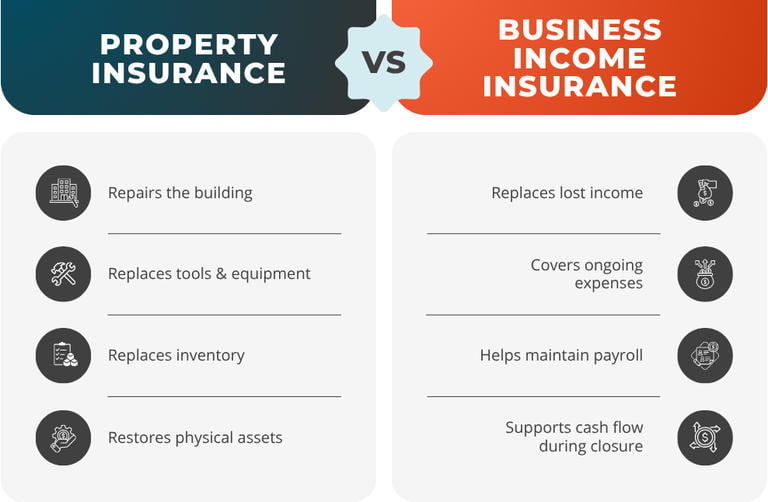
While property insurance pays to rebuild the walls and replace the business owned tools, it does not pay for the money you lose while your business is closed. Rebuilding a specialized automotive repair facility takes time, often much longer than most owners realize. During those months of forced closure, your revenue stalls, but your bills do not stop arriving. Payroll, mortgage payments, property taxes, rent, and utility baselines keep piling up.
This is where business income insurance becomes the thin line between a temporary setback and permanent bankruptcy. For automotive businesses, this coverage is not a luxury; it is the financial life support system that keeps your business alive when the worst happens.
What is Business Income Insurance or Business Interruption Insurance Coverage?
In the simplest terms possible, business income insurance coverage, frequently referred to by owners as business interruption insurance, is designed to protect your cash flow when a covered physical loss either completely shuts down your shop or significantly reduces your ability to operate at full capacity.
Some owners also know this coverage as loss of income or time element insurance. No matter the terminology used on your declarations page, the underlying financial mechanics are identical. If you’re forced to close for months, this protection steps in to provide the necessary income to pay for ongoing operating expenses that don’t disappear during a shutdown, like:
- Net profits that your shop would have earned if the disaster hadn’t happened.
- Fixed overhead costs like rent, mortgages, insurance premiums, and taxes.
- Ongoing operational expenses required to maintain your corporate footprint.
- Key employee payroll and technician salaries.
Think of it as a financial bridge. Property insurance repairs the physical structure, while business income insurance replaces the revenue stream that keeps your business entity legally and financially intact while construction takes place.
Why the Stakes Are Higher Today
Five years ago, a shop owner might’ve assumed that a major property claim would sideline them for 30 to 60 days. In the pre-COVID economy, local contractors were readily available, permitting moved quickly, and automotive shop equipment could be shipped and installed within a few weeks.
Today, the economic landscape for the automotive services industry has completely shifted. Securing business income insurance is far more critical to monitor today than it was just a few years ago. The timeline for getting an auto repair facility or body shop back to full operational status has dramatically lengthened due to several macroeconomic factors:
1. Longer Construction Timelines
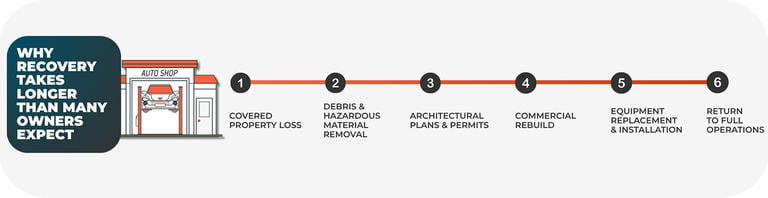
If a shop suffers a total fire loss, the process begins with debris and hazardous material removal, which can take weeks or even months. Following that, architects must draft plans, and local municipalities must approve permits. Because of current labor shortages in commercial construction, a rebuild that used to take three months now routinely stretches to eight, ten, or twelve months.
2. Specialized Equipment Lead Times
Auto repair shops, collision centers, and quick-lube facilities rely on specialized, heavy machinery. If your frame machines, advanced vehicle diagnostic systems, alignment racks, or custom paint booths are destroyed, you can’t simply buy replacements off the shelf. Supply chain friction means that ordering, shipping, and calibrating specialized automotive equipment can take months, keeping your bays and stalls empty long after the physical structure is rebuilt.
Because of these extended delays, shop owners must ensure their business income insurance features a payout timeline — noted on your policy as the period of indemnity — that matches today's real-world reconstruction timelines. Having a policy with a payout window that is too short can leave you paying out of pocket long before your shop is ready to reopen.
Protecting Your Most Valuable Asset
For any automotive repair or collision business, your most valuable assets don’t sit in the tool chest or on the parts rack. Your most valuable assets are your technicians.
Finding highly skilled, certified automotive technicians is one of the greatest challenges in the industry today. If your shop is forced to close for six months due to a tornado or fire, what happens to your team? If you stop paying them, they can’t afford to wait for your building to be reconstructed. They will take a job with your direct competitor. When your shop finally reopens its doors, you’ll have a beautiful new building with no staff to perform the labor, impacting your professional reputation and operational capacity.
This highlights one of the most critical gaps in traditional, off-the-shelf commercial insurance policies. Many standard insurance companies place strict sub-limits on employee wage reimbursement, capping payroll coverage at 60 or 90 days, or excluding it entirely. If your shop takes nine months to rebuild, a 60-day payroll limit leaves your technicians without income for seven months.
To avoid this, it is critical to seek out policies that utilize an actual loss sustained model that includes key employee and technician coverage for up to a full 12 months during the rebuilding and recovery process. Keeping your service team paid and intact is essential for preserving your local reputation and ensuring you can immediately hit the ground running the day your bays or stalls reopen.
Total vs. Partial Disruptions
Business interruption claims in the automotive space are rarely simple, and they don’t always involve the worst-case scenario. Automotive repair operations face nuanced risks that require adaptable insurance responses.
The Partial Loss Scenario
Imagine a six-bay mechanical repair shop experiencing an isolated electrical fire that completely knocks out three bays and destroys a major alignment rack. The other three bays are physically untouched, but the shop’s capacity is instantly cut in half.
Similarly, under a specialized auto body repair shop insurance policy, a localized fire in a paint mixing room could halt finishing work entirely while leaving the structural integrity of your prep and assembly bays fully intact.
Mitigation tactics and proactive record-keeping are vital here. By acting quickly and leveraging extra expense coverage, the shop can fund temporary measures to keep those remaining bays operating at maximum output.
Extra expense coverage pays for the unexpected, non-normal costs of keeping your doors open — such as setting up temporary work areas, rerouting utilities, or renting specialized machinery. However, how it is structured within your policy matters immensely. In many standard commercial policies, this emergency funding is treated as a siloed, optional add-on with its own distinct limits and waiting periods. If these coverages are separated, you may find yourself unable to access cash quickly enough to prevent permanent damage to your customer base. For comprehensive protection, it should be seamlessly bundled directly into the core business income insurance policy under a single, unified framework, ensuring that mitigation efforts and income replacement work hand-in-hand without administrative delays or separate deductibles.
Multi-Location Shifts
If you run multiple locations or operate a franchise, you have a massive advantage when disaster strikes. If a storm knocks out your Northside shop, you don't have to hit pause on your entire business. You can immediately reroute customer appointments and send your flat-rate techs over to your Southside location. This keeps your crew working, keeps your customers from wandering to competitors, and protects your hard-earned reputation while adjusters sort through the damage.
Evaluating Your Policy
Because business income insurance is often bundled into a larger commercial property policy, many owners assume they’re fully covered without checking the specific fine print on their declarations page. When evaluating commercial insurance for auto repair shops, you should contact your current insurance provider and ask these four questions:
What is the specific waiting period before coverage kicks in?
Business income deductibles are measured in time, not dollars. The industry standard is typically a 72-hour waiting period. You need to know exactly how many days your shop must absorb the total loss of income before the insurance policy begins paying out.
Is there a hard dollar limit on my business income reimbursement?
Many traditional companies underwrite business income to a rigid stated dollar amount (e.g., capping coverage at $500,000). If your rebuild takes longer than expected or inflation drives up costs, you can easily exhaust that limit before your doors reopen. Look for policies that offer actual loss sustained coverage up to a full 12 months.
Will this policy fully pay my technicians' wages and commissions for the entire duration of a shutdown?
Ensure there are no hidden sub-limits or short timeframes (like 60-day caps) on employee payroll that will cause your experienced labor force to find another employer.
Are business income and extra expense coverage bundled together?
You should never have one without the other. Verify that your policy automatically includes the extra funds necessary to temporarily mitigate your loss, rent alternative space, or shift operations to keep your brand visible.
The Direct-to-Insured Advantage
When your business experiences a catastrophic event, it’s a stressful, emotional time. Everything you've built is temporarily halted. The last thing an automotive business owner needs during a crisis is to play telephone through a multi-layered insurance broker network.
In a traditional insurance model, an owner reports a claim to their agent. The agent acts as the middleman, passing it to the insurance carrier. When an adjuster is finally assigned, any questions or updates must filter back through that same extended chain. This introduces lag, confusion, and generalities during a time when every single day of delay costs your business money.
Intrepid Direct Insurance operates on a specialized direct-to-consumer model. We don’t use traditional agents or brokers; we work directly with you.
Because our sales, underwriting, service, and claims teams all operate under one roof, we eliminate the middleman completely. If a customer experiences a multi-million dollar business income loss, our client success advisors and claims adjusters work hand-in-hand. We don't speak in vague generalities. We map out exactly what day one, week four, and month six will look like, providing direct three-way communication channels to reassure owners and issue ongoing reimbursement checks quickly after the initial waiting period. This specialized, personal touch offers real peace of mind when your livelihood is on the line.
Designing for Your Worst Day
No automotive business owner likes to dwell on worst-case scenarios. It's easy to look at clean bays and a busy schedule and believe "it won't happen to me."
But commercial insurance shouldn't be bought to protect your best days; it's purchased to protect your business on its worst day. Business income coverage is the ultimate defensive asset for your balance sheet.
When evaluating options, working with a generalist agent who insures local bakeries, florists, and retail boutiques often results in coverage gaps. To get the most out of insurance for auto repair shops, you need specialized programs built specifically for the automotive sector. By partnering with an industry specialist like Intrepid Direct, you leverage deep automotive repair business expertise, real data, and an actual loss sustained model designed to keep your staff paid, your brand intact, and your business positioned to reopen successfully.
Talk with one of our industry experts to review your current policy and identify potential coverage gaps before a shutdown exposes them.
Products and services of Intrepid Direct Insurance described above are provided by one or more insurance company subsidiaries of W. R. Berkley Corporation. Not all products and services may be available in all jurisdictions, and the coverage provided by any insurer is subject to the actual terms and conditions of the policies issued. Information in this publication is subject to change at any time. This publication provides general information only, is not legal advice, and is not a statement of contract. While reasonable care has been utilized in compiling this information, no warranty or representation is made as to accuracy or completeness. Any statement regarding insurance coverage made herein is subject to all provisions and exclusions of the entire insurance policy. Claims scenarios are provided for example purposes only. The outcome of any claim is dependent on the specific facts and circumstances of the claim, as well as the policy provisions in effect at the time of the loss. © 1999 Intrepid Direct Insurance. All rights reserved.
Categories
Recent Posts

Request a Quote
Ready to take control of your insurance? Request a quote and get the coverage you need all in one place. Remember your broker can’t access us and we don’t interfere with their marketing.